
On Slow Art
January 2026: A letter for people whose souls could use a rest.

Dear family, friends, and Internet strangers,
In my October letter, I mentioned a worsening chronic illness; it’s since been diagnosed, and with a more targeted approach to treatment, I began to improve just in time to enjoy Christmas. Then it got worse again, then better (but still not stable). I’m not sleeping enough. My usable hours feel painfully truncated.
A tired brain and variable energy levels have contributed to the lateness of this letter. I suppose all of this also contributed to my decision to write about what people call “slow art” this month.
Slow to Create
“Slow art” can mean a lot of things. One artist strongly associated with slow art is Makoto Fujimura, whose paintings taught me to appreciate the beauty and value of abstract art.
David Brooks wrote an article for The New York Times (“Longing for an Internet Cleanse”, 28 March 2019) in which he described Fujimura’s unusual ability to slow down for beauty:
“His paintings are gorgeous works of abstract expressionism, using a Japanese style called Nihonga. He grinds colored minerals like malachite and azurite into fine particles and then layers them on paper. Each layer takes time to dry, and Mako may use 60 layers in a single work.”
I’ve read elsewhere that Fujimura has, on occasion, followed a Japanese artistic tradition of intentionally using silver that will tarnish so the work will slowly change as time passes.
As a visual artist, I don’t seem to have the patience for creating true slow art, as my ideas outrun my brushes and escape the sketchbook.
But I do feel better when I take the time to stop and paint something, or when I can focus on a time-consuming recipe. I enjoy the break from information that comes from hand-mending a hole in a piece of clothing without trying to listen to an episode of something.
The whole idea of creating slow art is a contrast to my ability to hop online and view other peoples’ beautiful art for a few seconds, then move on, ad infinitum. It’s a contrast to the deluge of input that drowns my now-fragile attention.
I do slower, or more attentive, art as a writer. Somewhat akin to nihonga, “each layer takes time to dry” when I write, walk away, think about it, even forget about it, and return to write again. Unlike tarnishing silver, the typed words saved in each document don’t change on their own, but my ideas develop in my time away from the page.
As an editor, I have to do multiple passes for different aspects of a work, or of a chapter of a work, to catch everything.
There’s a painting by Fujimura named after a short story by J. R. R. Tolkien, “A Leaf by Niggle”, that Fujimura created after his traumatizing 9/11 experience.
Fujimura writes that he painted an invisible tree with watermarks in the midst of the work, and he chose to leave it as it was, seemingly unfinished. Twenty-two years later, he visited the work in a museum in China. In his post about the painting, he says, “I was startled to find, after 22 years later, that it IS complete whole now, because of the watermarks revealing themselves more and more. The tree had generatively become whole.”
I associate slow art with the work that goes into it; I think it’s easy to miss the seemingly empty hours, days, or years where the art can develop on its own. It’s uncommon for visual artists to do this intentionally. Fujimura’s willingness to let beauty and meaning grow over time seems to be an echo of his life as a Christian, as God works in us, His people, even when we don’t think anything active is happening.
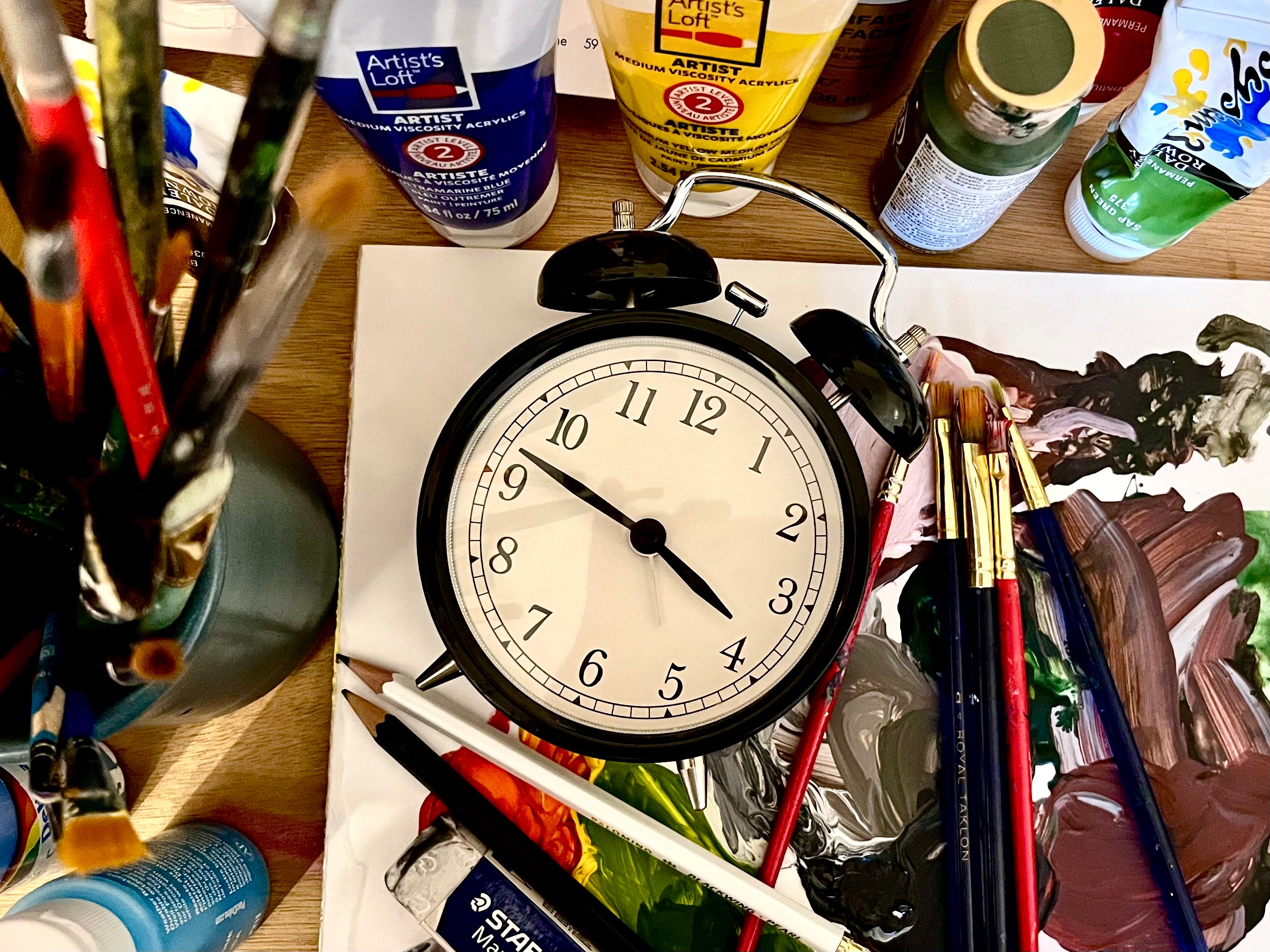
One piece of writing I did manage to finish this quarter was a guest blog post I began for my friend Tina Marie Cox over a year earlier. I’d told her I had an idea for a post, and then time slipped away, and I didn’t pick it up again for many months.
The post refers specifically to autumn, when the birds come to eat the seed pods of summer plants, and I didn’t want to let the season get away from me yet again without completing it. I was able to finish the piece, and I sent it to Tina Marie.
I realized as I worked on it, after so many months, that I’d developed as a person and was therefore able to write a much better post. I also had been worried about a small unwanted outcome, which led to the situation described in the post, and waiting a year actually allowed me to find out what happened.
More than that, the post came at exactly the right time for my friend, who was wanting to publish something on her blog in a particularly busy season. Without either of us knowing it before I sent her the finished document, I was able to be an instrument in solving her problem.
The topic of the post itself was exactly this type of thing, where God works with our little to do something beyond our expectations. It’s as if Someone planned the whole thing, fish-and-loaves-esque, and my slowness didn’t thwart Him even slightly.
(To read the December 9 post on Let’s Be Real, use this link: “Birds, Seeds, and Work That Matters”. It’s largely about the balance of rest and work for a Christian, what it means to join God in His work, and what it truly means to do work that matters. I’ve also linked it under “Writing Updates” below.)
Sometimes taking breaks is the best option, and allows something to develop in the meantime, like a slow-simmering stew. Sometimes the empty space is me squandering time and making poor choices, though. Slow art often needs the empty space, and it needs the active hours to lovingly create the work.
The need to know the difference led me to draft my writer’s serenity prayer a couple of years ago: “Lord, grant me the serenity to accept when I literally cannot write due to health issues or higher priorities. Grant me the courage, inspiration, and focus to do the work when I am able to write. And bless me with the wisdom to know the difference.” (I’d like to remember to pray it from time to time.)
Slow to See
“Slow art” is not only about the reduced pace of creating, but also the pace of enjoying works.
In his NYT article, Brooks writes, “Nihonga is slow to make and slow to see. Mako once advised me to stare at one of his paintings for 10 to 12 minutes. I thought it would be boring, but it was astonishing. As I stood still in front of it, my eyes adjusted to the work. What had seemed like a plain blue field now looked like a galaxy of color.”
Fujimura has written about how to see his paintings, and it appears Brooks understood the instructions.
Because I haven’t had the opportunity to view the artist’s work in person, I must be missing a huge portion of what makes it worth looking at. I enjoy the work as it appears online, but it’s only while researching it further for this letter that I learned the viewing of it is part of what makes it slow.
When it comes to the written word, reading and listening to someone speak are two different ways of absorbing information, and since reading allows me to control the pace (sometimes skimming, sometimes re-reading sentences) and engage more intentionally than listening, I prefer it, even though it effectively precludes multitasking.
I also prefer movies and shows that require my full attention. I know lots of people scroll on their phones while watching shows, but I’d rather choose content I’m actually interested in.
Choosing to be slow, limited, and focused might feel difficult when the deluge of information won’t stop. What is worth taking my time to do, to look at, to enjoy, to think over deeply? What do I allow to pass by me?
Consider slow art in the sense of craft: a locally made wooden spoon, small-batch Turkish textiles, and even more widely produced things like my mom’s Longaberger baskets that were hand-woven in Ohio and passed along to me. There’s a beauty that comes from the attention that went into them, and they stand clearly contrasted against the mass-manufactured things throughout the house. Like most slow art, these require attention to really see the difference. A stainless steel spoon works just as well for most purposes as a wooden one, goes in the dishwasher, and doesn’t need to be waxed. A machine-woven towel or basket would be less costly than a hand-woven one. When is “slow” worth it? Why?
It even costs time to evaluate things like that. And, as with most things in human life, sometimes we get it wrong. But it’s worth it. It’s worth cultivating focused attention, wisdom, discipline, and discernment by creating and enjoying slow art and writing.
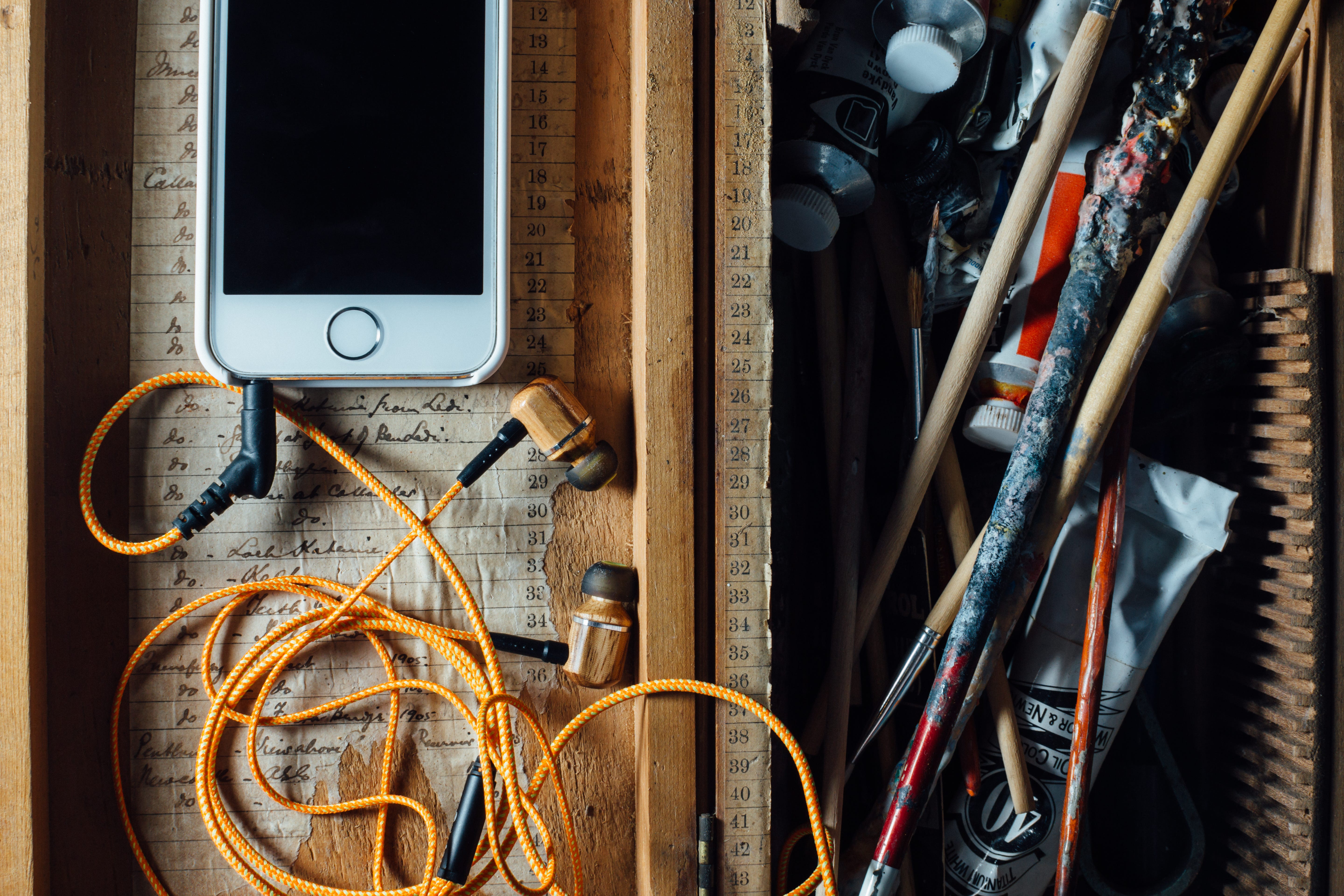
The work of a modern artist might include making better use of frenetic new formats and pacing expectations (short-form video, podcasts, various formats of social post) rather than rejecting them.
Maybe it’s possible to use newer media to encourage deeper thinking and edification. But when we scroll on social media, are we still seeking such things?
Slow to Fully Understand
It seems slow art requires the space in between, whether the pauses in creating or the slowing down to enjoy a work. I think of Tolkien’s twelve years (or seventeen, depending who you ask) spent on The Lord of the Rings, stopping and starting throughout the process.
During one of those stops, unsure he would ever finish LotR, Tolkien had a dream that quickly became his short story “Leaf By Niggle”. I read the story for the first time this month, and like most quality work, it keeps coming back to mind. Tolkien famously said he hated allegories, yet it reads very plainly as an allegory for Tolkien’s work (and his anxieties and his work avoidance).
Tolkien took little time to write it, but it seems to be “slow” in other ways. A superficial reading of it yields less than a reading that attempts to understand the allegory. There are also ideas I can try to apply, to see if they work in real life. I can understand his story more as I think about it and read about it.
Being slow to completely understand is a valuable asset of slow art because seeking understanding is a valuable facet of being human. I’m not speaking of works that are intentionally obtuse for pretentious reasons, or works that are confusing because of a failure of the creator to communicate, but works that include depth and meaning on multiple levels, creating layers of beauty and interest.
The Holy Bible fits this. Due perhaps solely to Divine inspiration, there are continually new treasures to be found in the 66 books throughout a long lifetime.
The Bible may, in fact, be the peak example of slow art, created over centuries by many people, beginning with oral records that predated the writings, slow to read well, slow to understand fully, richer with every attempt.
The books, short stories, and essays I want most to read, and the works I hope to write, are those that are written thoughtfully, slowly, from the deepest part of a human soul reflecting the Imago Dei. I want to read what’s worth remembering.
I want to write what you will remember long after you put it down.
Writing Updates
As mentioned above, I wrote a guest post for my friend Tina Marie Cox’s blog, Let’s Be Real, that was published in December: “Birds, Seeds, and Work That Matters”. What does it mean to join God in His work, or to do what matters?
A science fiction novel I edited is now available on Kindle and as a paperback: Gannon: The Prophet of Fomalhaut by Mark Weber. If you read it and enjoy it, please leave a review for this first-time author! I expect to start editing the sequel in the coming months.
Things I Appreciate About Our Local Library
The Indianapolis Public Library has given me access to a wide range of useful content, including, obviously, actual physical books, but also:
Kanopy for free streaming of a decent selection of movies and shows, including Perfect Days (2024) and Little Forest (2018), two low-stress favorites of mine
The Libby app for digital access to books, including audiobooks
Free access to certain periodicals, including The New York Times (which I used to view the article by David Brooks above) and Consumer Reports
Annual seed library in the spring, which allowed me to plant dill, parsley, lettuce, and marigolds last year for free
Not that access to more content helps any of us slow down, but if your library offers such, it could help you sit down with a good book, a slow movie, or a long article, or even get into the garden in the spring.
That’s it for this January! If any of this was valuable to you—interesting, useful, or beautiful—share it with someone:
To truth, love, and adventure,
Rae
These Letters are 100% organic human writing—no AI involved.
If you missed a Letter, or just want to re-read one, visit the archive.
For more info about me or my work, visit my website.
If you like using Facebook for some reason, follow my writer page!
Disclaimer: All the views I express within this publication and on social media are my own, and do not necessarily match the views of any person or institution associated with me.